
In the modern accelerated digital world, where online shopping is now a normal everyday occurrence, an excellent online presence is not a choice anymore but a necessity. Businesses are investing in eCommerce website development services that cater to their specifics of online presence activities that do not only reflect the brand but also improve the customer experiences and increase their conversion.
The modern consumer does not demand a merely functional site, but rather a memorable, user friendly, and customized online shopping experience that will speak to them in their values and quality as a brand.
In the increasing competition among industries, the strength to become noticeable online depends on the capability of the brand to reach their audience in terms of design, technology, and narratives. The growing e-commerce market is estimated to generate 1.3 trillion U.S. dollars in revenue in 2025.
By 2029, U.S. consumers’ appetite for online shopping is forecast to bring in 1.8 trillion U.S. dollars. An established eCommerce site does not just sell, but conveys credibility, feeling and genuineness. Combining ingenuity and utility, custom eCommerce platforms are assisting brands in the USA to remodel the digital shopping experience of the customer.
Building a brand through customization
Among the largest opportunities of the custom eCommerce WordPress website development services are the possibilities to create a platform that best matches the personality and vision of the brand.
A web template that fits all businesses cannot convey the uniqueness of a business, and so a handcrafted eCommerce solution can. Businesses develop a cohesive all-over image by incorporating brand colors, typography, and message, which reinforce brand memory.
As an example, a New York based boutique fashion store will require a smooth, minimalist layout displaying business products of high quality whereas a craft store in Austin, Texas will require a warm, artistic design. Under custom development, the businesses will be able to produce a look and feel that is indicative of their identity, a thing that is impossible to achieve with generic templates.
Enhancing user experience and navigation
The experience that a user undergoes in a site is significant in ensuring that the user either buys the product or not. Intuitive navigation, quick loading, and evident calls to action are the primary concerns of the best eCommerce development services. Such factors do not only lower the bounce rates, but they also develop trust and satisfaction of the visitors.
Being able to locate what they need with the help of smart categorization, advanced filters, or customized suggestions, customers have a higher chance to keep being engaged and make a repeat purchase. In addition to this, optimized navigation has a direct effect on the performance of SEO, where it assists brands to draw in greater organic traffic.
Mobile responsiveness and cross-platform optimization
More than 70 percent of online purchasers in the United States make purchases on mobile devices. Therefore, responsive design isn’t optional—it’s mandatory. Mobile-friendly platforms provide the user with the same user-friendly experience regardless of whether they’re browsing from smartphone, tablet, or desktop.
San Francisco based company that employs responsive eCommerce design can be used to serve customers on various platforms without the need to compromise design and functionality. Custom development will make sure that all buttons, menus, product pages will-customize to the various sizes of the screen that will result in not missing out on sales due to poor mobile usability.
Strengthening security and customer trust
Security is the backbone of any eCommerce business. Customers need to be confident in the security of their personal and payment information. Custom built platforms have a high level of security than off-the-shelf solutions.
Developers will be able to add high-levels of encryption by providing advanced SSL certifications, encrypted gateways, and two-factor authentication to make transactions safe.
An electronics company in Los Angeles dealing in the sale of high-end electronics can be sure that sensitive data is kept safe but at the same time a smooth check out process is achieved. Such a safe network does not only safeguard the users but also strengthens brand confidence and trust, which have an immediate effect on conversions.
Streamlining operations for B2B businesses
The b2b eCommerce development services industry in the USA has risen tremendously due to the demand by companies to have efficient online mediums to handle large scale transactions.
The B2B eCommerce websites usually need special functions that include bulk ordering, tiered pricing, account-based logins and custom invoicing. Reports suggest that only 35% of B2Bs have an established lead nurturing strategy.
For example, a wholesale distributor located in Dallas might require a system which could allow customers to see special prices depending on their business level or credit record.
The complex requirements are met through the custom development without compromising the performance and security standards. The B2B customers want a fast, accurate and transparent service which can only be achieved by having a unique platform.
Creating a seamless checkout experience
The checkout process is the moment of truth for every eCommerce site. The complex or lengthy checkout can lead to card abandonment. User friendly, simplified design of the checkout, various payment methods and guest checkout feature are some of the reasons why the conversion rates are increased.
Custom platforms allow integration with digital wallets like Apple Pay, PayPal, and Google Pay, giving customers flexibility and confidence. An Atlanta-based business that optimizes its checkout process can witness a significant drop in abandoned carts and an increase in completed sales.
The long-term impact on brand identity
Other than design and functionality, tailor made eCommerce development fosters brand presence and emotional attachment. The homepage design, the tone of product description, and all other details make the customers have a certain attitude towards the brand. Trust and loyalty is developed with time through the unique, reliable and engaging online presence.
A company that continually offers value and quality on its online platforms becomes an unforgettable brand. Whether it’s a family-owned business in Denver or the tech retailer that is on the rise in Boston, the site is becoming a part of the brand narrative that is entrenched in the mind of the customer.
The future of custom ecommerce development
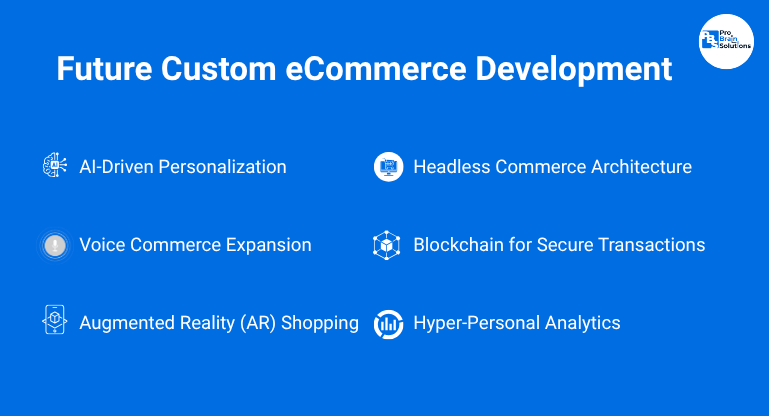
Global eCommerce sales will account for $6.86 trillion in 2025, which is an 8.37% increase from 2024.With the ongoing advancement in technology, the custom eCommerce development will determine the future of online businesses. Here’s what the future looks like:
1. AI-driven personalization
The use of Artificial Intelligence will bring personalization to the next level. The future eCommerce websites will interpret behaviour automatically to provide real-time pricing, personalized content and product recommendations that change with each visitor.
2. Voice commerce expansion
Voice shopping will become a normal practice with the emergence of intelligent devices such as Alexa and Google Home. Voice search will be incorporated in custom-built sites to enable online shopping to be faster and easier.
3. Augmented reality (AR) shopping
AR will be the solution that will bridge the gap between online and offline shopping. Customers will have the ability to see products in real-life settings such as trying clothes virtually or seeing furniture in their living rooms.
4. Headless commerce architecture
Headless commerce allows greater flexibility by separating the front end from the back end. It implies that the brands will be able to provide content to be streamed across many devices and channels including apps and IoT devices without the need to reshape the core system.
5. Blockchain for secure transactions
The blockchain technology will transform the transparency and security of payment. It will allow traceable transactions, increase consumer confidence, and curb fraud in international eCommerce.
6. Hyper-personal analytics
Advanced analytics tools will enable the businesses to anticipate trends, automate their marketing strategies and provide superior customer retention programs using predictive data modelling.
The future is to develop smarter, faster and more personalized digital experiences that will not only convert users, but also make them have an emotional connection to brands.
Conclusion
Custom eCommerce development is not merely developing a web site, but developing a digital identity that reflects the values and promises of your brand. Personalized design to save payment systems all these will make the customer experience a more trustable and engaging process. Businesses across the USA are realizing that a tailor-made platform gives them a competitive edge—helping them connect emotionally with their audience and drive measurable growth.
Whether it is optimizing user experiences, incorporating new powerful technologies, or expanding operations, custom eCommerce development allows brands to transform in line with the ever-evolving market. Finally, it enhances brand recognition and conversions – which are the reasons why customization is the answer to long-term digital performance.
FAQs
1. What makes custom eCommerce development different from using templates?
Custom development enables companies to create platforms that reflect their brand, with their specific functionality, and can scale up as time passes, unlike rigid pre-made templates.
2. How does eCommerce website development improve conversions?
It enhances the speed of sites, navigation, checkout procedure and personalisation- aspects that affect the user experience and stimulate purchases.
3. Are custom eCommerce solutions more secure than ready-made ones?
Yes. Custom-made websites can include high security functions, which are customized to suit the requirements of a specific brand and reduce the risks of attacks and scams.
4. How do B2B eCommerce services differ from B2C platforms?
B2B platforms address bulk purchase, tier pricing and account access and B2C sites are concerned with individual customer purchase and simplified purchase.
5. Why is mobile optimization crucial for eCommerce success?
The mobile-optimized websites are accessible to most of the shoppers using their mobile devices, hence a high level of engagement and conversion.