
Nowadays, in the digital-first era, healthcare providers can no longer consider their website as an information source only, but the entrance to their practice, hospital, or clinic. A well-designed healthcare website will aid in creating patient trust, enhancing the communication process, and eventually, boosting the number of appointments.
Companies that aspire to have this sort of quality frequently get custom website design services from Pro Brain Solutions, a familiar figure with the track record of creating healthcare and insurance websites that convert.
No matter which hospital or private practice, or even an insurance agency website you are designing, your online presence should be easy to use, responsive and reliable. This guide will discuss the best practices in healthcare website design, including the appropriate structure and website experience as well as real-life examples from the USA that are likely to inspire.
Understanding the purpose of healthcare website design
U.S. health care spending grew 7.5 per cent in 2023, reaching $4.9 trillion. The primary role of a healthcare web site is to enable the patients to access information within a short period and make rational decisions. It can be any appointment booking, search of a specialist, or reading of the treatment options, but the site must be easy to navigate.
Credibility should also be portrayed in healthcare websites. As an example, the Mayo Clinic (Minnesota, USA) possesses one of the most reputable healthcare sites in the world due to its combination of highly qualified medical information with clear and simple design and navigation.
Equally, an insurance quote website must be user experience oriented; that is, the site must ensure that the users could simply request quotes as well as compare them without any hassle and also comprehend the policies.
Best practices for a high-converting healthcare website
a. Prioritize accessibility and usability
Accessibility will make the site accessible to users with disabilities. The web pages of healthcare facilities must meet the standards of the ADA (Americans with Disabilities Act) – they must have readable fonts, correct contrast rate, alternative text in place of graphics and screen reader compatibility.
b. Create a mobile-first design
There is no compromise on a mobile responsive site. In the USA more than 70 percent of healthcare-related searches are done through mobile devices. Mobile optimization will keep patients engaging in their search and drop-offs will be eliminated whether they need urgent care or a home insurance compare sites tool.
c. Highlight trust and transparency
Patients desire to view credentials, genuine reviews, certifications, and secure browsing (HTTPS). These must be prominently displayed in healthcare websites. As an example, Cleveland Clinic (Ohio, USA) manages to combine testimonials, doctor bios, and patient resources to make credibility stronger.
d. Simplify navigation
Users should never feel lost. Only 5-7 major options in the main navigation menu, such as Find a Doctor, Book Appointment, Services, About Us, and Contact. Make calls-to-action (CTAs) visible and action oriented e.g. Schedule Now or Get Care Online.
Must-have features for healthcare websites
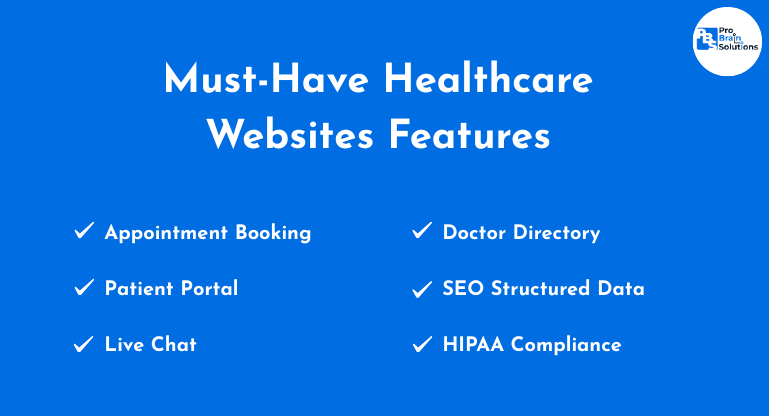
The following are the key elements, which render healthcare websites both functional and engaging:
- Appointment booking system: Allow patients to schedule visits directly.
- Patient portal integration: A safe access to the medical records and test results.
- Live chat or chatbot support: To get instant assistance or book an appointment.
- Doctor directory: The users have an option of locating physicians according to the specialty, experience, or location.
- SEO optimization: Add structured data, keywords in healthcare-related keywords and geo-targeted content to enhance visibility.
- HIPAA compliance: Safeguard confidential patient information with high privacy standards.
Even non-healthcare websites, such as a website that compares car insurance quotes, adhere to the same principles – they make the choices easier, have concise CTAs, and guarantee the fact that the data security regulations are followed.
Content strategy: speak to patient concerns
Great healthcare websites educate users, not overwhelm them. Your content ought to be well understood, empathetic and factual. Add blogs, FAQs and descriptions of service, which directly provide answers to the questions of the patients.
When you have an insurance agency website, for instance, your blog post might be about such subject as “How to select the appropriate Health Coverage” or “How to Understand Deductibles vs. Premiums”. This positions your brand as a reliable advisor.
SEO and performance optimization
Having a beautiful site is worth nothing when no one will be able to see it. Healthcare providers should consider partnering for a custom insurance SEO services quote to boost their visibility on search engines. It is vital that there be local SEO, content rich in keywords, fast page loading speeds and schema markup, and moreover, according to projections, the global market for SEO will reach $143.9 billion by 2030.
Website speed, especially, affects bounce rates and Google rankings. Optimize pictures, apply a minimal structure, and do not use lot of animations. The best site to compare auto insurance rates will also be based on the lowest possible design clutters to guarantee fast page loading and improved conversions.
Security and compliance
Health care websites deal with confidential information on a daily basis. This places cybersecurity as a priority. Portals should be secured with SSL certificates, encrypted forms, and two-factor authentication.
Besides, make sure that HIPAA (Health Insurance Portability and Accountability Act) is adhered to compliance. The breaches may result in substantial fines and mistrust.
Real-world examples of great healthcare website design
1. Cleveland Clinic (Ohio, USA): Visually organized, well-structured, and user-friendly design, focusing on patient care services.
2. Mount Sinai (New York, USA): It has contemporary visuals, there are fast links to departments and simple ways of making a schedule.
3. Kaiser Permanente (California, USA): It is a combination of a minimalist design and explicit CTAs to make appointments and insurance management.
4. Florida Blue (Florida, USA): As an insurance-focused healthcare provider, it combines both healthcare and insurance tools for easy quote comparison — making it feel like a hybrid insurance agency website.
All these websites strike a balance between user experience, mobile responsiveness, credible content and these are major ingredients of successful design.
Integrating comparison tools and quote systems
A comparison tool or quote form can be added that can make your healthcare or insurance site more interactive. For example, if you operate a health or auto insurance company, integrating a system similar to those used by home insurance compare sites can improve user experience and lead generation.
The most effective solution is to add the quote form on the relevant pages (not just the homepage). Make it very brief – not more than five fields – and include an indication of progress to minimize form abandonment.
In case your webpage sells more than one insurance product, use step-by-step filters to guide the customers, as it appears in the best insurance quote website platforms in the USA.
How design influences trust and conversions
Everything in healthcare is about trust. Patients can be reassured with a professional design, understanding images, and the brand image used throughout. Avoid flashy graphics or stock photos; be real with actual pictures of real staff, offices and testimonials.
Additionally, have distinct privacy statements and certifications in the footer. The conversion rates can be doubled by just placing a single smartly placed button of “Schedule Appointment” or “Request Quote”.
Successful examples of healthcare sites include telling stories, such as illustrating the experience of a patient, community outreach, and stories of excellent care.
Conclusion
An effective medical site is not just a web brochure, it is an instrument that establishes confidence, simplifies interaction with patients and increases your brand recognition. Regardless of whether you are a medical practice or an insurance agency website owner, your web site design must be geared towards accessibility, ease, and personalization.
For healthcare providers and insurers looking to improve conversions, optimize SEO, and enhance design, it’s best to get custom website design services from Pro Brain Solutions. Their experience and skills will make sure that your site will be not only visually attractive but also efficient, safe and conversion-oriented, and allow you to reach more patients and customers in the USA.
FAQs
1. How can I design my insurance website to generate more leads (quote requests)?
Focus on user flow — it is recommended to ensure that the CTAs such as “Get a Quote” or “Request Estimate” can be seen throughout the site. Short interactive forms and immediate chat can be used to provide prompt assistance to the visitors.
2. What are the essential ‘must-have’ features for a high-converting insurance agency website?
Add instant quote tools, customer reviews, user-friendly navigation, SSL security, and high value proposition on the top right.
3. Is my insurance website’s design mobile-friendly (responsive), and how much does that affect my business?
Yes, it must be. More than 60% of the visitors come from mobile. Unless your site is responsive, you might end up losing leads and SEO rankings.
4. What is the best way to integrate an instant quote tool or form onto my website?
Integrate it into the appropriate pages and reduce the field of input. Make it fast and easy by providing auto-suggestions and progress bars.
5. How can I use my website’s design to build trust and credibility with new visitors?
Show authenticated reviews, credentials, employee profiles and contact information. Be authentic, use secure browsing (HTTPS).
6. What pages are non-negotiable for an insurance agency website (Home, About Us, Contact, etc.)?
Some of the required pages are Home, About us, Contact, services, Blog and Quote request. These serve as the basis of usability and SEO.
7. How important is website speed, and what design choices slow down an insurance site?
The speed of the site is important in terms of conversions and search engine optimization. Use of heavy videos, large images, and unnecessary plugins that are likely to slow down the load time are to be avoided. Optimize by using CDN and image compression tools.